

August 5, 2024

January 6, 2026

1031 Exchange in Commercial Real Estate

The 1031 Exchange is a valuable provision under the U.S. Internal Revenue Code (Section 1031).

share

For sophisticated commercial real estate investors, portfolio growth is a game of strategic capital reallocation. You identify an asset that has reached its peak value. You sell it. You move that equity into a larger, higher-performing asset.

However, the friction of capital gains taxes can significantly erode the proceeds from that sale. If you lose 20% to 30% of your profit to taxes every time you trade up, your purchasing power diminishes rapidly. This is where the 1031 Exchange comes in.

A 1031 exchange, named after §1031 of the U.S. Internal Revenue Code, is not a loophole. It is a government-sanctioned tool designed to encourage reinvestment. It allows you to defer paying capital gains taxes on an investment property if you reinvest the proceeds into a "like-kind" property.

This guide serves as your comprehensive framework. We will cover the core mechanics, the strict timelines you must follow, and the strategic reasons to use this tool for wealth preservation.

The Core Principle: Deferral, Not Elimination

It is critical to understand that a 1031 exchange is a tax deferral strategy, not a tax elimination strategy. You are essentially kicking the tax can down the road.

When you sell a property and execute a valid exchange, your cost basis from the old property carries over to the new property. You do not pay taxes on the gain at the time of the transaction. This allows you to keep 100% of your equity working for you. You only pay the capital gains tax if you eventually sell the new property for cash without doing another exchange.

Many investors use this strategy repeatedly throughout their lives, swapping properties until they pass away. Under current tax law, their heirs receive a "step-up in basis," which can effectively eliminate the deferred capital gains tax liability entirely. This makes the 1031 exchange one of the most powerful estate planning tools in commercial real estate.

Why Investors Use the 1031 Exchange

Saving money on taxes is the obvious benefit. But the strategic advantages go deeper.

1. Increased Purchasing Power

This is the "interest-free loan" concept. By deferring the tax payment, you have more capital to invest. For example, if you owe $100,000 in capital gains taxes but defer it, that $100,000 serves as the down payment on your new property. With 65% loan-to-value (LTV) financing, that saved tax money allows you to control an additional $300,000 worth of real estate.

2. Portfolio Diversification

You might own one high-value apartment complex that concentrates all your risk in one location. A 1031 exchange allows you to sell that single asset and split the proceeds to buy three different net-lease properties in three different states. You diversify your risk without triggering a tax event.

3. Asset Consolidation

Conversely, you might be tired of managing ten small rental properties. You can sell them all and roll the proceeds into one large, institutional-grade asset, like a grocery-anchored shopping center. This reduces your management headache while maintaining your equity.

4. Resetting Depreciation

Depreciation is a non-cash deduction that lowers your taxable income. Over time, you may use up the depreciation on a property. A 1031 exchange allows you to acquire a new building with a higher value, potentially increasing your depreciable basis and shielding more of your rental income from taxes.
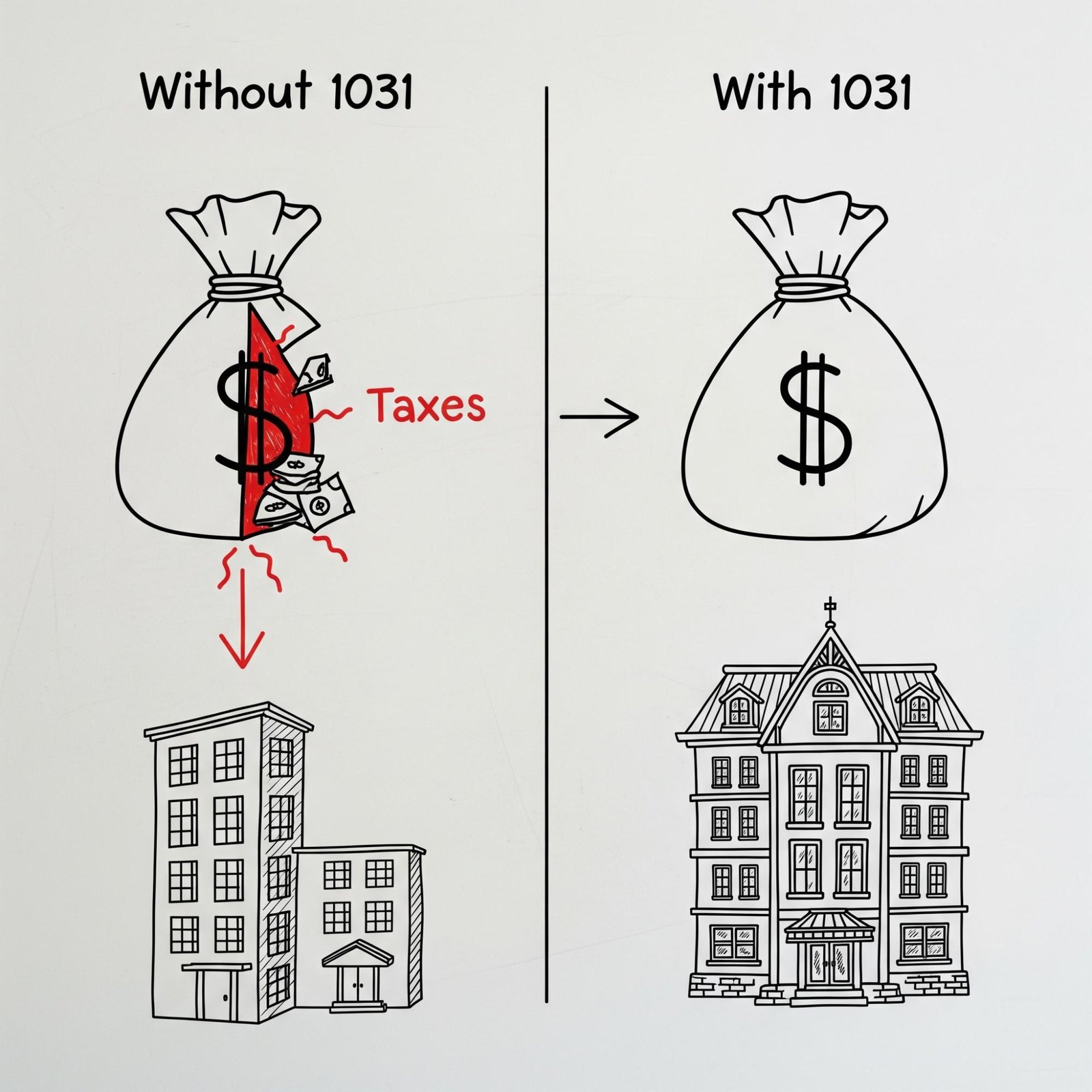
Graphic comparing 1031 exchange reinvestment vs paying taxes.
A 1031 exchange allows you to reinvest the full proceeds of your sale, increasing your purchasing power.

The Four Ironclad Rules of the Exchange

The IRS is strict. If you miss one step or deadline, the exchange fails, and you owe the full tax bill.

1

The Like-Kind Requirement

The replacement property must be "like-kind." In CRE, this is broad. You can exchange office for warehouse, or land for retail. However, you cannot exchange investment property for a personal residence. Read our analysis: Defining "Like-Kind" for 1031s.

2

The Qualified Intermediary (QI)

You cannot touch the money. If sale proceeds touch your bank account, the exchange is invalid. You must hire a QI before closing to hold funds in escrow.

3

The Equal or Greater Value Rule

To defer 100% of taxes: 1) Buy a property of equal or greater value. 2) Reinvest all net cash proceeds. Any difference is "Boot" and is taxable.

4

The Title Requirement

The taxpayer who sells must be the taxpayer who buys. If "ABC LLC" sells, "ABC LLC" must buy.

Interactive Boot Calculator

$
$

Estimated Taxable Boot

*You may owe taxes on this amount.

*Great job! Potential for full deferral.

The Critical Timeline: 45 and 180 Days

The 1031 exchange is a race against the clock. There are two deadlines, and the IRS rarely grants extensions.

0

Day 0: Closing

The clock starts the day you close the sale of your relinquished property.

45

Day 45: Identification Deadline

You must identify potential replacement properties in writing to your QI. 3-Property Rule: Identify up to 3 properties of any value.

180

Day 180: Closing Deadline

You must close on your new property. This runs concurrently with the 45-day clock.

"The 45-day window is the tightest part of the deal. We always advise clients to start looking for their replacement property BEFORE they even list their current property for sale. You want to hit the ground running the moment your contract is signed." – Gomez Group

Navigating Potential Pitfalls and Advanced Strategies

Finding Replacement Properties

The 45-day identification window is tight. A proactive search for your replacement property should begin long before your original asset is sold. Having a backup property identified is also a smart strategy.

Poll: What is the biggest challenge for investors in a 1031 exchange?

Thanks for voting!

Timing and inventory are the most common hurdles.

Advanced Exchanges

What if you find the perfect deal before you've sold your old property? Or want to renovate using tax-free dollars? These scenarios are possible through Reverse Exchanges and Improvement Exchanges.

Frequently Asked Questions

Can I do a 1031 exchange on my primary residence?

No. Only for investment or business-use properties.

How many times can you do a 1031 exchange?

No limit. You can "swap 'til you drop," holding assets until death for a step-up in basis.

Can I move into a 1031 property?

Not immediately. Safe harbor rules suggest holding for investment for at least two years first.

Execute Your Strategy with Confidence

A 1031 exchange is a powerful wealth-building tool. Navigating these timelines requires a broker who understands the pressure you are under. At Gomez Group, we specialize in helping investors identify and secure replacement properties within strict 1031 deadlines.


1031 Exchange in Commercial Real Estate

In the realm of commercial real estate, the 1031 exchange, also known as a like-kind exchange or a Starker exchange, is a valuable provision under the U.S. Internal Revenue Code (Section 1031). This provision allows investors to defer paying capital gains taxes on the sale of an investment property by reinvesting the proceeds into a new property of like-kind. This tax deferral mechanism is a powerful tool for real estate investors aiming to expand their portfolios, preserve capital, and enhance their investment returns. This article explores the intricacies of a 1031 exchange, including its benefits, requirements, and potential pitfalls.

Benefits of a 1031 Exchange

A 1031 exchange provides several significant benefits for investors. The primary advantage is the deferral of capital gains taxes, which can be considerable depending on the property’s appreciation and the investor’s tax bracket. By deferring these taxes, investors can reinvest the entire proceeds from the sale into a new property, thereby leveraging a larger amount of capital for their next investment. This tax deferral essentially serves as an interest-free loan from the government, with the taxes deferred until the investor eventually sells the replacement property without further exchange.

Portfolio Diversification and Consolidation

1031 exchanges offer flexibility for investors to diversify or consolidate their real estate holdings. For instance, an investor might sell a single, high-value property and use the proceeds to acquire multiple properties in different locations, thereby spreading risk. Conversely, an investor with several smaller properties might consolidate their holdings into a single, larger property, simplifying management and potentially increasing income. This flexibility allows investors to adapt their portfolios to changing market conditions, investment strategies, and personal goals without the immediate tax burden that would typically accompany such transactions.

Depreciation Benefits

Another significant benefit is the ability to reset depreciation on the new property. Depreciation is a valuable tax deduction that allows investors to offset a portion of their property’s value against taxable income each year. When an investor acquires a new property through a 1031 exchange, the depreciation schedule starts anew based on the purchase price of the replacement property. This can provide additional tax benefits, particularly if the replacement property is of higher value than the relinquished property.

Requirements for a 1031 Exchange

Executing a 1031 exchange involves several stringent requirements and rules that must be followed to qualify for the tax deferral. Both the relinquished property (the property being sold) and the replacement property (the property being acquired) must be held for investment purposes or used in a trade or business. Properties held primarily for resale, such as inventory in a development project, do not qualify.

Like-Kind Requirement

The like-kind requirement is another critical aspect of a 1031 exchange. The term “like-kind” refers to the nature or character of the property, not its grade or quality. In practical terms, this means that most real estate properties are considered like-kind to each other. For example, an investor can exchange an office building for a shopping center, an industrial property for a multifamily complex, or even vacant land for a commercial building. However, certain property types, such as primary residences or properties located outside the United States, do not qualify for a 1031 exchange.

Timing and Deadlines

Timing is crucial in a 1031 exchange, with two specific deadlines that must be adhered to strictly. First, the investor has 45 days from the sale of the relinquished property to identify potential replacement properties. This identification must be in writing, signed by the investor, and delivered to the qualified intermediary handling the exchange. The identification can include up to three properties of any value or more than three properties if their combined value does not exceed 200% of the relinquished property’s value. The second critical deadline is the 180-day period for acquiring the replacement property. This period begins on the closing date of the sale of the relinquished property and runs concurrently with the 45-day identification period. Therefore, the replacement property must be acquired within 180 days of the initial sale.

Role of a Qualified Intermediary

A qualified intermediary, also known as an exchange accommodator, is essential to the 1031 exchange process. The intermediary facilitates the exchange by holding the proceeds from the sale of the relinquished property and using those funds to purchase the replacement property. At no point can the investor take possession of the sale proceeds, as doing so would disqualify the transaction from 1031 exchange treatment. The qualified intermediary ensures that the exchange complies with IRS regulations and that the investor does not inadvertently trigger a taxable event.

Value Requirements

To defer all capital gains taxes, the replacement property must be of equal or greater value than the relinquished property. If the replacement property is of lesser value, the difference, known as “boot,” is subject to capital gains tax. Boot can also arise if the investor receives any cash or other non-like-kind property as part of the exchange. Managing the transaction to avoid this is crucial for maximizing the tax deferral benefits of a 1031 exchange.

Potential Pitfalls and Challenges

While the 1031 exchange offers significant tax advantages, it also comes with potential pitfalls and complexities that investors must navigate carefully. One common challenge is finding suitable replacement properties within the 45-day identification period. In competitive real estate markets, this can be particularly difficult, and investors may need to conduct thorough market research and engage real estate professionals to identify potential properties quickly.

State-Level Considerations

Additionally, investors must be aware of potential tax implications at the state level. Some states have their own rules and regulations regarding 1031 exchanges, and not all states conform to federal 1031 exchange rules. Investors conducting exchanges involving properties in different states must ensure compliance with all applicable state regulations to avoid unexpected tax liabilities.

Reverse and Improvement Exchanges

Reverse exchanges and improvement exchanges offer additional flexibility but also come with increased complexity and risk. In a reverse exchange, the investor acquires the replacement property before selling the relinquished property. This requires the qualified intermediary to take title to the replacement property temporarily, which can complicate financing and management. Improvement exchanges allow investors to use exchange funds to improve the replacement property. However, the improvements must be completed within the 180-day exchange period, which can be challenging for significant construction projects.

The Power of the 1031

A 1031 exchange is a powerful tool in commercial real estate, enabling investors to defer capital gains taxes, preserve capital, and strategically grow their portfolios. By understanding the benefits, requirements, and potential pitfalls of 1031 exchanges, investors can make informed decisions and leverage this tax-deferral mechanism to achieve their long-term investment goals.

Related Articles

Perform a commercial lease audit to protect your asset value. Avoid these 7 fatal red flags.

May 15, 2026

Identify the best cities for CRE investment. Learn why Dallas, Phoenix, and Nashville offer winning returns for buyers in 2026.

May 1, 2026

Business owners are choosing commercial real estate sale-leaseback in 2026. Learn 5 reasons to unlock capital & pay down debt.

April 17, 2026