
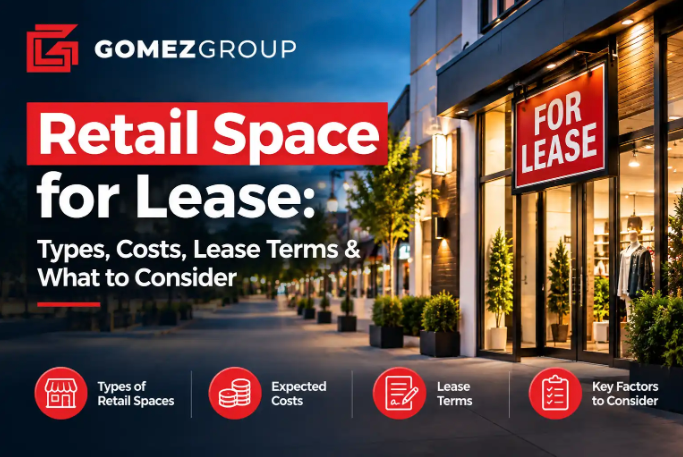
A great retail location can attract customers, support daily operations, and influence your business’s long-term growth. But choosing the right retail spaces for lease takes more than comparing monthly rent.
You need to consider location, property type, total costs, lease terms, parking, visibility, and future business needs. Start by setting a realistic budget and listing your must-have features before touring properties.
This guide explains the key factors to compare so you can evaluate your options and make a more informed leasing decision.
Key Takeaways
- Identify the property type that fits your business model and customer needs.
- Compare standalone stores, strip centers, shopping centers, and mixed-use developments.
- Check visibility, parking, accessibility, and nearby businesses before choosing a location.
- Review rent, operating costs, signage rules, and other lease requirements.
- Make sure the space supports your current operations and future business plans.
Start by Defining What Your Business Needs
Before viewing properties, identify what your business actually needs. A clothing store may require different features than a restaurant, salon, or grocery store. Make a simple list of must-haves and nice-to-haves.
When comparing retail spaces for lease, you may also find properties available for purchase. If ownership is a long-term goal, exploring a retail plaza for sale can help you compare both options.
For businesses seeking flexibility without buying, a retail space for rent can provide a practical way to establish a physical location.
Understand the Main Types of Retail Properties
Different retail properties work better for different businesses. Consider visibility, customer traffic, accessibility, and nearby businesses before choosing a space.
Standalone Stores
These spaces are occupied by one business and often offer more control over the storefront and customer experience.
Potential benefits:
- Better storefront visibility
- More signage control
- Dedicated parking in some locations
- Greater control over operations
Strip Centers
Strip centers group several storefronts in one development. They can offer shared customer traffic, convenient access, and nearby complementary businesses.
Shopping Centers
Shopping centers range from small neighborhood properties to larger retail destinations. Check parking, access, operating costs, signage rules, and the tenant mix before leasing.
Mixed-Use Developments
Mixed-use properties combine retail with residential, office, or entertainment spaces. They can provide access to nearby customers while offering a convenient business location.
Calculate the Full Cost Before Signing
The monthly rent is only one part of your retail occupancy budget. Additional charges can significantly change the amount you actually spend.
Think of your costs in three categories:
1. Rent-related costs
- Base rent
- Rent increases
- Security deposit
2. Property-related costs
- Property taxes
- Insurance
- Common area maintenance
- Landscaping
- Security
- Trash removal
3. Business setup costs
- Renovations
- Fixtures
- Equipment
- Furniture
- Signage
- Permits
- Moving expenses
Ask for a detailed estimate of all expected charges before comparing properties. A space with lower advertised rent may not necessarily have the lower overall cost.
Compare Lease Structures Carefully
The lease structure determines how different property expenses are divided between the landlord and tenant. This can have a major effect on your total occupancy costs.
Here are some common structures:
| Lease Type | General Structure |
| Gross lease | Tenant generally pays rent while the landlord covers many property expenses |
| Net lease | Tenant pays rent plus some property expenses |
| Modified gross | Certain expenses are divided between the landlord and tenant |
| Percentage lease | Tenant may pay base rent plus a percentage of sales |
These are general descriptions, and actual lease terms can vary.
Review the Lease Term and Renewal Options
A lease can affect your business for several years, so do not focus only on the starting rent.
Pay attention to the terms that determine what happens throughout the agreement.
Check These Details
- Lease length: Know when the agreement begins and ends.
- Renewal options: Find out whether you have the option to continue leasing the property and how renewal pricing is determined.
- Rent increases: Check when increases occur and how they are calculated.
- Termination terms: Understand the conditions under which either party can end the agreement.
- Subleasing and assignment: Determine whether you can transfer the lease or sublease the space if your circumstances change.
A flexible lease may be particularly important for newer businesses, while established retailers may place more value on long-term location stability.
Evaluate the Location Beyond Foot Traffic
A busy street does not automatically make a property suitable for your business. What matters is whether the people visiting the area are likely to become your customers.
Use this simple location check:
- Visibility → Can customers easily see the storefront?
- Accessibility → Can customers conveniently reach the property?
- Parking → Is there enough parking for customers and employees?
- Traffic patterns → Can customers easily enter and exit?
- Surrounding businesses → Do nearby businesses attract a similar or complementary audience?
- Future development → Could nearby construction or new developments affect the area?
Visit the property at different times and on different days when possible. This gives you a better understanding of how the area actually functions during your expected business hours.
Check the Condition and Layout of the Space
A property can look attractive during a quick tour while still requiring significant work before opening.
Take time to inspect both the building and the interior layout.
Look Closely At
- Electrical systems
- Plumbing
- Heating and cooling
- Lighting
- Flooring
- Walls and ceilings
- Restrooms
- Doors and windows
- Storage areas
- Loading access
- Fire and safety systems
Then consider how customers will move through the space.
Can they enter easily? Is there enough room for displays? Is the checkout area practical? Can employees work efficiently?
Sometimes, a smaller space with a functional layout can be more useful than a larger property that requires extensive changes.
Compare Properties With a Simple Checklist
When comparing retail properties for lease, create one comparison sheet and use the same criteria for every property.
This keeps your decision based on consistent information rather than first impressions.
| Comparison Area | Questions to Ask |
| Location | Is it convenient for the target customer? |
| Size | Is there enough usable space? |
| Rent | What is the base monthly cost? |
| Extra expenses | What additional charges apply? |
| Lease | How long is the agreement? |
| Condition | What repairs or improvements are needed? |
| Parking | Is parking convenient and sufficient? |
| Signage | What signage is permitted? |
| Layout | Does the space support daily operations? |
| Growth | Can the location support future needs? |
Keep this information for every property you visit. It makes side-by-side comparisons much easier.
Consider the Investment Side
Retail property can serve both business and investment goals. A shopping center investment property may provide rental income but also involves costs such as financing, maintenance, taxes, vacancies, and property management.
Leasing can give business owners access to a commercial location without buying the property, while ownership involves different financial responsibilities. The right approach depends on your capital, goals, and willingness to manage the property.
Know How to Find the Right Location
If you are wondering how to find retail space for lease, begin with your business requirements instead of simply searching for the most attractive property.
Follow This Process
Step 1: Define your target area.
Identify the neighborhoods or trade areas where your customers are most likely to shop.
Step 2: Set your budget.
Consider both base rent and additional occupancy expenses.
Step 3: Create your must-have list.
Decide on minimum space, parking, visibility, access, and other requirements.
Step 4: Shortlist properties.
Remove properties that clearly do not meet your essential criteria.
Step 5: Visit in person.
Check traffic, accessibility, surrounding businesses, property condition, and layout.
Step 6: Compare the lease terms.
Look beyond rent and review responsibilities, increases, renewal options, and other conditions.
Step 7: Review before signing.
Make sure you understand the complete agreement and financial obligations.
Working with a commercial real estate professional can also help you identify suitable properties and better understand local market conditions.
Review Everything Before Signing
A retail lease is a significant commitment, so avoid making a decision based only on appearance or advertised rent.
Also think about your future needs. If your business grows, you may need more storage, parking, employees, or customer space.
A property that works today should also make reasonable sense for where you expect your business to go.
Choose Your Retail Space With Confidence
The right retail location should fit your budget, customer needs, and long-term business plans. Compare the property, total costs, lease terms, and location before making your decision.
Ready to explore your retail options? Contact Gomez Group to discuss available commercial properties and find a space that fits your business needs.
Frequently Asked Questions
1. What should I look for when leasing retail space?
Focus on location, accessibility, visibility, size, parking, total occupancy costs, property condition, lease terms, and restrictions that could affect your business.
2. What costs should I expect besides monthly rent?
Depending on the lease, you may also pay taxes, insurance, maintenance, utilities, common area expenses, repairs, signage, and other property-related costs.
3. How long should a retail lease be?
There is no single ideal lease length. Consider your business stability, growth plans, market conditions, and need for flexibility when reviewing the term.
4. Can I negotiate a retail lease?
Some lease terms may be negotiable depending on the property and landlord. Potential areas for discussion can include rent, lease length, renewal options, tenant improvements, and certain operating expenses.
5. Should I lease or buy a retail property?
Leasing can provide flexibility without requiring the purchase of a property, while buying involves ownership and its associated financial and operational responsibilities. Compare both options against your business and investment goals.