

You found the perfect location. The rent fits your budget. The visibility is excellent. The landlord is ready to sign. You sign the lease, pick up the keys, and apply for your business license.
Then the city rejects your application.
The property is not zoned for your specific business type. You are now legally obligated to pay rent on a space you cannot occupy.
This nightmare scenario happens more often than investors realize. Commercial zoning laws are the invisible framework that dictates value and usability. Whether you are a tenant looking for space or an investor looking to acquire a value-add asset, zoning is your first hurdle.
Ignorance of local codes is not a defense. It is a liability. This guide outlines the 5 critical mistakes business owners and investors make regarding zoning, and how to verify permitted use before you commit capital.
Mistake 1: Assuming Commercial Zoning Laws Are Uniform
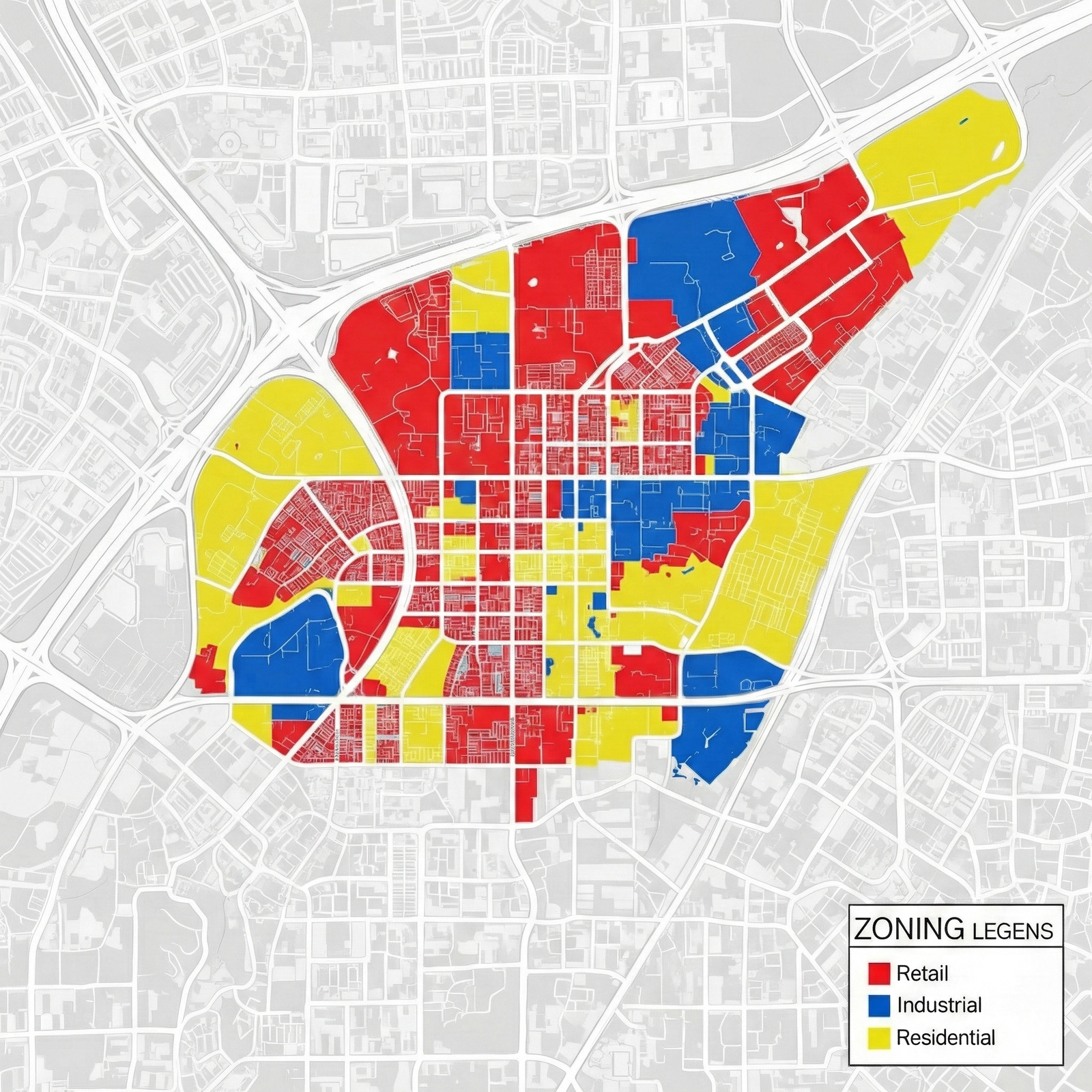
The most common error is assuming "Commercial" means "Anything Commercial." It does not. Zoning codes are hyper-local. They vary by city, county, and specific overlay districts.
Understanding the Hierarchy
You can usually move "down" the intensity scale, but rarely "up." You must verify the specific municipal code. Tools like GIS mapping can help you visualize these districts. We discuss this in our article on Using GIS Mapping in Commercial Real Estate.
Mistake 2: Failing to Verify "Permitted Use" vs. "Conditional Use"
Every zoning district has a table of uses. This table classifies your business in one of three ways:
The Danger of the Conditional Use Permit (CUP)
Many high-value businesses fall into the "Conditional" category, including Quick Service Restaurants with drive-thrus.
If your use requires a CUP, do not sign a lease without a contingency. The process can take 3 to 6 months. If you sign a lease without a "Zoning Contingency" clause, you are liable for the rent even if the city denies your permit.
"We once advised a gym franchise looking at a prime retail box. The rent was great, but the zoning required a CUP for 'Indoor Recreation.' The landlord pushed for a standard lease. We negotiated a 90-day contingency. The city denied the permit due to parking concerns. That contingency saved the client $1.2 million in lease liability." – Ryan Gomez
Mistake 3: Ignoring the "Parking Problem"
Parking is often the deal-killer in commercial real estate. Commercial zoning laws dictate strict parking ratios based on the square footage and the type of use.
The Change of Use Trap
Investors often look for "Value-Add" opportunities by converting old retail space into medical use. This is a smart strategy, as discussed in our Trends in Retail Spaces analysis.
However, medical tenants require more parking than general retail. If you convert a shoe store (low parking) into a dialysis center (high parking), the building may no longer comply with the code. The city will deny the Certificate of Occupancy unless you can physically add more spaces.
Mistake 4: Overlooking "Legal Non-Conforming" Status
Older buildings often do not meet current zoning codes. They are allowed to exist because they were built before the rules changed. This is called "Grandfathered" or "Legal Non-Conforming" status. This status is fragile.
The Burn-Down Rule
If a grandfathered building is damaged by fire, you may not be allowed to rebuild it as it was. You would be forced to rebuild according to current codes, which could mean a smaller building.
The Vacancy Rule
If a grandfathered use sits vacant for too long (often 6-12 months), it loses its status. The city will force the new tenant to comply with current zoning.
Read more about evaluating older assets in our guide on Commercial Real Estate Due Diligence.
The Zoning Red Flag Checklist
✅ Zoning Review Complete.
Mistake 5: Misunderstanding Mixed-Use Complexity
Mixed-use environments combine residential, retail, and office elements. This creates vibrant assets, as detailed in our post on The Rise of Mixed-Use Developments.
However, mixed-use zoning is complex. It often involves strict rules about noise, odors, and hours of operation to protect residential tenants upstairs. A restaurant might be prohibited from installing a commercial exhaust vent or have strict closing times.
If you are acquiring or leasing in a mixed-use zone, you must read the specific "Planned Unit Development" (PUD) documents. Learn more in our definition guide: What is Mixed-Use Zoning?.
How to Verify Your Strategy
Step 1: Get the Zoning Verification Letter
Request a formal Zoning Verification Letter from the city planning department. This document confirms the current zoning of the parcel and lists any known violations.
Step 2: Check the Certificate of Occupancy (CO)
Ensure the space has a valid CO. If you plan to change the use (e.g., office to retail), know that you will need to apply for a new CO. This triggers a building inspection.
Step 3: Consult a Local Expert
Zoning is local. A broker who specializes in Illinois Commercial Real Estate understands Chicago's specific wards. A broker in Texas understands Houston's unique lack of zoning. You need local guidance.
Protect Your Investment
Zoning dictates value. A property that allows for a drive-thru is worth more than one that does not. At Gomez Group, we help investors and business owners identify properties with the right entitlements to support their goals. Whether you are looking for Grocery Anchored Shopping Centers or industrial land, we verify the details that matter.